iPad – The Good, the Bad and the Possibilities
February 2010
By The Architect
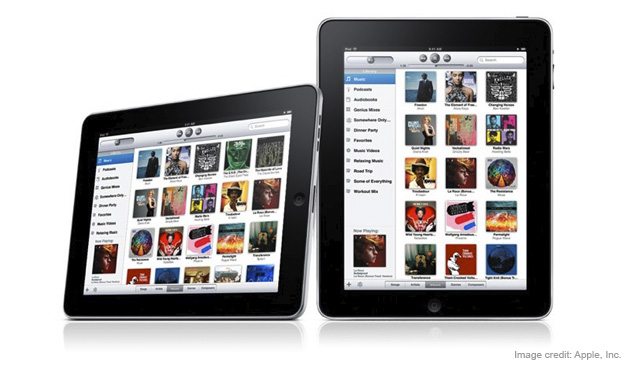
Apple’s January 27 “latest creation” media event was historical for many reasons – not the least of which was the introduction of the first real tablet.
Never before has such anticipation surrounded the launch of single product, and rightfully so. When was the last time you read a book on your laptop? How satisfying is it to surf the Web on your smartphone, even if it is an iPhone? There has long been a gap in the usability of these devices for casual media consumption – a gap that Apple has now bridged with the iPad.
As Steve Jobs noted in his keynote address, when developing the iPad, Apple set out to create a new category of devices that would surpass both the laptop and the smartphone in handling key tasks like browsing the Web, sending e-mail, viewing and sharing photographs, watching videos, enjoying music, playing games and reading eBooks.
With the iPad, Apple has indeed succeeded in carving out a new category in the mobile device marketplace – one that makes digital content accessible in a posture that has been comfortable and familiar to humans for centuries.
As with any first-generation technology, the iPad offers many exciting and novel features, but it is not without its drawbacks. However, these details pale in comparison to what is most significant about the device. By offering a new platform, the iPad promises to revolutionize media as we know it today – from the way we consume it to the way it is created, packaged and marketed – bringing sweeping changes to our culture and a number of industries along the way.
Here's Fame Foundry's take on all things iPad:
The Good
- Revolutionary, unhinged tablet computing device in book-holding posture
- Addresses all core functions desirable in a mobile computing device: Web browsing, e-mail, address book, calendar, notes, photos, music, video
- Capability to create and edit documents, spreadsheets and presentations with iWork apps
- Ready to run 140,000 existing apps out of the box
- iBooks available to purchase and read on-demand
- Potential to accelerate the growth of the emerging marketplace of “cloud” products, computing and storage
- Hardware is thin (.5 inches thick), lightweight (1.5 pounds) and elegantly designed
- Full-color screen with multi-touch interface
- Sheds the bulk of input devices
- Bezel allows for comfortable holding without accidental touches
- Excellent battery life
- 30-pin peripheral extension
- Wireless and 3G capable
- Built-in Bluetooth 2.1
- Accessible price point: $499 for 16GB model with no 3G support to $899 for 64GB model with 3G support
The Bad
- No system achieved to allow non-Apple apps to run simultaneously with other apps while balancing responsiveness and battery life
- Needs broader networking capabilities for access to nearby computers
- Presents some challenges in the device’s keyboard interface and standing upright when needed (which can be solved with compatible accessories)
- No camera or capability to video chat – an already established system available even on low-end MacBooks and the MacBook Air
- No GPS device
What Will Change
- This is the beginning of the end of paper. As a handheld device that does more than the Kindle – in full color and with a touch-driven interface, innovative software and well-balanced interface design – the iPad will force print publishers to choose one of two paths: create innovative content systems and monetize or file for bankruptcy.
- You will actually be able to watch video easily and comfortably in your hand and in settings never before feasible with a computer or pocket device. In fact, the experience will even rival a high-definition movie, as holding a 10-inch tablet 14-18 inches away is the same as watching a 96-inch television 10 feet away.
- Casual computing on low-end laptops will diminish. Netbooks will need to redefine themselves or be banished to the same dismal corner of the market as underperforming MP3 players in the portable music category.
- Portable TV and video players will begin to fade into obscurity, and physical media such as DVDs and Blu-ray discs will continue to go the way of VHS tapes and Betamax.
- The Kindle’s price will drop substantially, or the device will cease to exist all together. Maybe both.
- Apple will bridge the interoperability gap between its devices, improving networking and file sharing dramatically. Macs, iPhones, iPads and AppleTV to make a bona fide push toward conquering your desk, your pocket, your lap and your living room.
- The iPad OS will continue to evolve away from its iPhone-like genesis.
- The App Store will see a bona fide split between iPad and iPhone apps.
- iPad apps – and perhaps even the OS – will accommodate more handwriting and drawing functionality. Consider what Newton did 15 years ago with the benefit of today’s advancements in software development.
- Apple declared war on Flash a long time ago, and the iPad’s lack of support for the plug-in is the latest incarnation of this. Expect developers to continue to evolve away from Flash, undermining Adobe’s long-running stranglehold on the Web.
- Gaming will enter a completely new frontier previously untouched by the iPhone platform and traditional computers.
- In the next generation of the iPad, Apple will develop an acceptable multitasking subsystem that balances performance and function and will introduce other hardware features such as a front-facing camera that will finally make the long-awaited video phone a reality. The second generation will also likely come with an even lower price point, boosting demand and furthering the iPad’s infusion into our culture.
Suffice to say, the iPad will sell well and will become firmly ingrained in the day-to-day lives of the masses – as have the iPods and iPhones that came before it. It comes with an already established, robust and broad platform of apps that is unprecedented. It is produced and backed by a company that is renown for ongoing innovation and, as with all its previous devices, will undoubtedly be improving upon the platform.
Like it or not, the iPad will become a part of our everyday lives and will change everything. Perhaps not in 2010, but soon after.
Below Fame Foundry's agents weigh in with their reactions and predictions for the iPad and its potential as a catalyst for change:

-
The Architect
The truth is, Apple’s iPad is a tablet – and only a tablet. While it possesses the capabilities of many existing devices, it is not a netbook, nor a personal computer, nor a pocket device.
It is, however, what the tablet was supposed to be all along: an easy-to-use, book-sized platform for content and communication, with software and an interface that allow for possibilities never before realized. As such, the true significance of the iPad lies in the long-term impact it will have on our culture.
Putting aside all initial criticisms in not living up to the dreams of every power user, early adopter and fanboy, the iPad is unquestionably a game-changer. Imagine everything that currently exists in print at book or tablet size being completely data-driven and interactive. Expect to see your UPS driver carrying it. Expect to see your medical charts on it. Expect an interactive Sports Illustrated to be published with capabilities that are unattainable with current Web standards.
Just as assuredly as the iPod and iPhone took three generations to hit their full stride in the marketplace, so will the iPad in revolutionizing content, communication and computing. The iPad’s first phase is now in play.

-
The Craftsman
Although not the end-all, be-all device I was hoping for, the iPad – along with various other tablet devices – is ushering in a new era of personal computing and media consumption.
The possibilities of a device like this are endless. The way people are consuming and interacting with media is changing. Virtually all forms of media will be affected by the move toward a handheld digital format, especially the newspaper and publishing industries.
What a device like the iPad does so well is consolidate and present content, replacing volumes of books, magazines, papers and other forms of media. Students can empty out their backpacks and have every required book downloaded to their iPad.
I also think we will see a shift from an emphasis on developing for the Web to developing applications. Apps will be the primary way content is delivered in the future. Until now, apps were lacking the right device to truly take off as a mainstream platform, but I think that device has finally arrived.
But iPad went beyond media consumption when they redesigned the entire interface for iWork. I was intrigued to see how applications like Pages, Keynote and Numbers will work on a multi-touch, gesture-based device. I think the future of interface design is very exciting.

-
The Author
The iPad is, first and foremost, a media consumption platform. However, this device is not as revolutionary in and of itself as are the changes it makes possible in the types of media that will be available to be consumed.
Hardware developers have long struggled to create an interface that is comfortable for reading or viewing for extended periods of time. Now that Apple has solved this problem, as the public embraces the iPad and it becomes as ubiquitous as iPods and iPhones, we will see the emergence of a new kind of audience with evolving expectations.
As demonstrated at the January 27 event, iBooks and the New York Times app are a step in the right direction for handheld digital media. However, given time, artists, writers and developers have unlimited potential to work together in changing the media consumption experience as we know it.
Currently, media is segmented by format, vehicle and purpose. Books, newspapers, magazines, radio, television and movies stand alone as distinct entities. However, the iPad presents new possibilities for blurring the lines between these various media types.
eBooks can become increasingly interactive, enhanced by images, animation, video and sound to offer more than just digital versions of printed texts. If movies have soundtracks, who is to say books can’t as well? Writers, designers, illustrators, animators and composers will have unprecedented opportunities for creative collaboration.
Currently news outlets produce separate content for broadcast or print and for the Web. Even though an online news story might include a video or audio clip to support written text, they are not seamlessly integrated. The iPad makes this possible in ways that will offer a richer, more informative experience.
Furthermore, as the iPad and other tablets eventually become the default media consumption device of choice, there will no longer be a need for entertainment to conform to a rigid half- or hour-long format for TV or two-hour movies. Instead, writers and producers will have the freedom to find new and innovative ways to produce entertaining content that is both profitable and better suited to the consumption habits of the end user.

-
The Creator
As a designer, there’s only one thing that excites me about the iPad, and it’s not the elegant design, the slick interface, the incredible battery life or the low price.
What really excites me is the iPad’s single most valuable offering — its potential to revitalize the suffering publishing industry and revolutionize journalism. As I watched the native version of the New York Times demonstrated at Apple’s "newest creation" event, a progressive yet familiar medium was being revealed.
Unlike the iPhone, the iPad mimics the size and portability of traditional printed material such as books and magazines. In the example of the New York Times, the design of the page is easy on the eyes and demonstrates how typography and page design can be preserved in digital media.
What’s more is there’s good news for advertisers, too. The creative ads we are accustomed to seeing in printed publications can be incorporated into page layouts for the iPad app, eliminating ineffective and obnoxious banner and pop-up ads that plague browser-based versions.
Like never before, the iPad makes it possible to combine the best of traditional publishing and journalism with the best of the Web. I don’t believe the iPad is destined to replace our workstations and laptops. Rather, it will become the standard vehicle by which we consume information. It is the new “paper.”
Behind every superstar website there is an architect, scrutinizing every single detail, cutting through the nonsense, and challenging every aspect to craft a masterpiece that gets noticed and gets results.