We are the digital agency
crafting brand experiences
for the modern audience.
We are Fame Foundry.

See our work. Read the Fame Foundry magazine.

We love our clients.

Fame Foundry seeks out bold brands that wish to engage their public in sincere, evocative ways.


WorkWeb DesignSportsEvents

Platforms for racing in the 21st century.

Fame Foundry puts the racing experience in front of millions of fans, steering motorsports to the modern age.

“Fame Foundry created something never seen before, allowing members to interact in new ways and providing them a central location to call their own. It also provides more value to our sponsors than we have ever had before.”

—Ryan Newman

Technology on the track.

Providing more than just web software, our management systems enhance and reinforce a variety of services by different racing organizations which work to evolve the speed, efficiency, and safety measures, aiding their process from lab to checkered flag.

WorkWeb DesignRetail

Setting the pace across 44 states.

With over 1100 locations, thousands of products, and millions of transactions, Shoe Show creates a substantial retail footprint in shoe sales.

The sole of superior choice.

With over 1100 locations, thousands of products, and millions of transactions, Shoe Show creates a substantial retail footprint in shoe sales.

WorkWeb DesignRetail

The contemporary online pharmacy.

Medichest sets a new standard, bringing the boutique experience to the drug store.

Integrated & Automated Marketing System

All the extensive opportunities for public engagement are made easily definable and effortlessly automated.

Scheduled promotions, sales, and campaigns, all precisely targeted for specific demographics within the whole of the Medichest audience.

WorkWeb DesignSocial

Home Design & Decor Magazine offers readers superior content on designer home trends on any device.


  • By selectively curating the very best from their individual markets, each localized catalog comes to exhibit the trending, pertinent visual flavors specific to each region.


  • Beside the swaths of inspirational home photography spreads, Home Design & Decor provides exhaustive articles and advice by proven professionals in home design.


  • The art of home ingenuity always dances between the timeless and the experimental. The very best in these intersecting principles offer consistent sources of modern innovation.

WorkWeb DesignSocial

  • Post a need on behalf of yourself, a family member or your community group, whether you need volunteers or funds to support your cause.


  • Search by location, expertise and date, and connect with people in your very own community who need your time and talents.


  • Start your own Neighborhood or Group Page and create a virtual hub where you can connect and converse about the things that matter most to you.

775 Boost email open rates by 152 percent

Use your customers’ behavior to your advantage.

655 The Rules for capturing the hearts of your customers: Don’t be needy

When it comes to building healthy relationships with your clients, it’s all about balance.

June 2021
Noted By Joe Bauldoff

The Making and Maintenance of our Open Source Infrastructure

In this video, Nadia Eghbal, author of “Working in Public”, discusses the potential of open source developer communities, and looks for ways to reframe the significance of software stewardship in light of how the march of time constantly and inevitably works to pull these valuable resources back into entropy and obsolescence. Presented by the Long Now Foundation.
Watch on YouTube

December 2016
By Kimberly Barnes

Going the Distance: Four Ways to Build a Better Customer Loyalty Program for Your Brand

Loyalty programs are no longer a novelty. That means that yesterday’s strategies won’t work moving forward, so look for ways to rise above the noise, setting yourself apart from the cloying drone of countless other cookie-cutter programs.
Read the article

Going the Distance: Four Ways to Build a Better Customer Loyalty Program for Your Brand

article-thedistance-lg It’s easy enough for a customer to join your loyalty program, especially when you’re offering an incentive such as discounts. All your customer has to do is give out some basic information, and voila! They’re in the fold, a brand new loyalty member with your company. From there, it’s happily ever after. You offer the perks; they stand solidly by you, bringing you their continued business. Simple. Or is it? In reality, just how many of those customers are act ively participating in your loyalty program? Do you know? Sure, loyalty program memberships are on the rise according to market research company eMarketer, having jumped 25 percent in the space of just two years. However, that figure may be a bit misleading. The truth is that, while loyalty program sign-ups may be more numerous, active participation in such programs is actually in decline. At the time of the study, the average US household had memberships in 29 loyalty programs; yet consumers were only active in 12 of those. That’s just 41 percent. And even that meager figure represents a drop of 2 percentage points per year over each of the preceding four years, according to a study by loyalty-marketing research company COLLOQUY.

When discounts just aren’t enough

So what’s a brand to do? How can you make your loyalty program worth your customer’s while—as well as your own? After all, gaining a new loyalty member doesn’t mean much if your customer isn’t actively participating in your program. Consider this: Does your customer loyalty program offer members anything different from what your competitors are offering? Chances are your program includes discounts. That’s a given. And what customer doesn’t appreciate a good discount? But when every other company out there is providing this staple benefit in comparable amounts, it becomes less and less likely that customers will remain loyal to any one particular brand. Frankly, it’s all too easy for customers to get lost in a sea of loyalty member discounts. They’re everywhere. In fact, just under half of internet users perceive that all rewards programs are alike, according to a 2015 eMarketer survey. The key to success, then, is to differentiate your business from the crowd. If you can offer your customers something unique and valuable beyond the usual discount, chances are they’ll be more likely to stick with your brand. Here’s some inspiration from companies who get it.

Virgin: Reward more purchases with more benefits.

That’s not to say you need to get rid of discounts entirely. In fact, nothing could be further from the truth. Customers still love a good discount. The goal is to be creative in terms of the loyalty perks you offer. Take the Virgin Atlantic Flying Club, for example. As part of its loyalty program, the airline allows members to earn miles and tier points. Members are inducted at the Club Red tier, from which they can move up to Club Silver and then Club Gold. Here, it’s not just a discount. It’s status. And people respond to feeling important, elite. Still, even where the rewards themselves are concerned, Virgin is motivating loyalty customers with some pretty attractive offers. At the Club Red tier, members earn flight miles and receive discounts on rental cars, airport parking, hotels and holiday flights. But as members rise in tiers, they get even more. At the Club Silver tier, members earn 50 percent more points on flights, access to expedited check-in, and priority standby seating. And once they reach the top, Club Gold members receive double miles, priority boarding and access to exclusive clubhouses where they can get a drink or a massage before their flight. Now that’s some serious incentive to keep coming back for more. Discounts are still part of the equation – but they are designed with innovation and personal value in mind, elevating them to more than just savings.

Amazon Prime: Pay upfront and become a VIP.

What if your customers only had to pay a one-time upfront fee to get a year’s worth of substantial benefits? It may not sound like the smartest business idea at first glance. But take a closer look. Amazon Prime users pay a nominal $99 a year to gain free, two-day shipping on millions of products with no minimum purchase. And that’s just one benefit of going Prime. It’s true that Amazon loses $1-2 billion a year on Prime. This comes as no surprise given the incredible value the program offers. But get this: Amazon makes up for its losses in markedly higher transaction frequency. Specifically, Prime members spend an average of $1,500 a year on Amazon.com, compared with $625 spent by non-Prime users, a ccording to a 2015 report from Consumer Intelligence Research Partners.

Patagonia: Cater to customer values.

Sometimes, the draw for consumers isn’t saving money or getting a great deal. The eco-friendly outdoor clothing company Patagonia figured this out back in 2011, when it partnered with eBay to launch its Common Threads Initiative: a program that allows customers to resell their used Patagonia clothing via the company’s website. Why is this program important to customers? And how does it benefit Patagonia? The company’s brand embraces environmental and social responsibility, so it was only fitting that they create a platform for essentially recycling old clothing rather than merely throwing it away. The Common Threads Initiative helps Patagonia build a memorable brand and fierce loyalty by offering its customers a cause that aligns with deep personal values. OK, so their customers get to make a little money, too. Everybody wins.

American Airlines: Gamify your loyalty program.

If you’re going to offer your customers a loyalty program, why not make it f un? After all, engagement is key to building a strong relationship with your customer. And what better way to achieve that goal than making a game of it. American Airlines had this very thing in mind when it created its AAdvantage Passport Challenge following its merger with USAirways. The goal: find a new way to engage customers as big changes were underway. Using a custom Facebook application, American Airlines created a virtual passport to increase brand awareness while offering members a chance to earn bonus points. Customers earned these rewards through a variety of game-like activities, from answering trivia questions to tracking travel through a personalized dashboard. In the end, participants earned more than 70 percent more stamps than expected – and the airline saw a ROI of more than 500 percent. The takeaway: people like games.

Stand out from the crowd.

Your approach to your customer loyalty program should align with your overall marketing approach. Effective branding is about standing out, not blending it. Being memorable is key. To this end, keep in mind that loyalty programs are no longer a novelty. That means that yesterday’s strategies won’t work moving forward, so look for ways to rise above the noise, setting yourself apart from the cloying drone of countless other cookie-cutter programs.


July 2010
By The Author

SEO 101: A Plain-English Primer

In today’s marketplace, if you want customers to find you, you need a sound foundation in SEO. To help you get started on the right track, we define in layman’s terms what SEO is (and what it is not).
Read the article

SEO 101: A Plain-English Primer

seo In today’s marketplace, when people have a question, want information or need to find a product or service, they don’t flip open the Yellow Pages. They don’t scour online directories. In May 2010, Americans conducted 15.9 billion searches*Instinctively, they turn to search engines like Google, Yahoo and Bing. As a result, these sites hold the keys to targeted encounters between you and prospects who are looking for a solution that you can provide. In May 2010, Americans conducted 15.9 billion searches* using the five major search engines. Of those, 63.7 percent were executed on Google sites, while Yahoo and MSN sites claimed 18.3 and 12.1 percent, respectively. That’s a tremendous pie, and you undoubtedly want a piece. Unlike in the days when the Yellow Pages ruled the world, you can’t buy your way to prominence on an organic search results page. Fortunately, you can take a proactive approach to determining where you land in the ranking for applicable product- or service-related keyword phrases through the practice of search engine optimization, known as SEO. Much is to be gained by appearing in the first few results of a search. Users want immediate answers and are not likely to wade through pages and pages of listings. Furthermore, because the major search engines have built their reputation on returning quality results, the higher your ranking, the more apt the consumer is to assume that your site will deliver the solutions they are looking for. Therefore, in the simplest form of the equation, a higher ranking equals greater probability of a user coming to your site, more prospects seeing what you have to offer and increased opportunities to convert visitors into customers. As a result, garnering a favorable position in the results for select search terms is one of the foundational aspects of effective marketing today.

What SEO is and what it is not

SEO is not a turn-key solution.Let’s be clear: SEO is not a turn-key solution. There’s no SEO magic dust that you can sprinkle over your site and instantly advance from page five to page one. The value of Google from the user’s perspective is the efficiency of entering search terms and receiving relevant and trustworthy results without having to sift through a sea of unpopular and unhelpful spammy sites. In fact, the major search engines are constantly advancing and sharpening their algorithms in order to ensure that they protect their stature as the gatekeepers of good information. What does this mean for you the business owner? Achieving the top spot does not come easily, and it takes an ongoing, dedicated investment of time and resources to work your way up through the rankings of a search. After all, if just anyone could fake their way to number one, Google would be worth nothing. Unfortunately, because of the growing importance of SEO, it has become a lucrative field for marketing agencies looking to make a quick buck. There’s a proliferation of snake-oil salespeople who would have you believe that SEO is a simple, one-time fix that will launch you to the top of the list and send your traffic numbers through the roof. This is for their benefit, not yours. As a result of the misinformation and half-truths preached by these shysters, it can be difficult to separate truth from fiction, both in terms of what it takes to improve your standing and what to expect once you do. SEO is a complex process, but you certainly don’t need to become an authority in the minutiae to grow your business successfully. However, you should have a foundational understanding in order to sort out the legitimate practices from those that will only waste your time and money.

The anatomy of a search engine

At a basic level, all search engines operate the same way. The Web encompasses billions of documents that are bound together through links. Search engines use these links to find and access individual web pages and files, using automated “spiders” to crawl and index the content contained therein. All of this information is stored in trillions of records that are tied to specific keywords or phrases. Therefore, when a user initiates a search, the engine doesn’t have to scan all of the many billions of web pages in existence. Instead, it must only access the particular record that holds the index of information pertaining to the terms entered, making it possible to retrieve vast amounts of data in mere fractions of a second. However, search engines do much more than pull back data and generate randomly ordered lists of links that are related to the terms entered in the query. Rather, the results are sorted and ranked based on importance, which is gauged according to relative popularity, following the assumption that a site or page is popular due to the quality of the information it contains. Therefore, the objective of SEO is not only to ensure that the major search engines identify your website content as being relevant to the keywords that pertain to your products or services but also to increase the perceived importance of that content.

Turning the tables on search

You are undoubtedly very familiar with the mechanics of using a search engine. These days, online search is as deeply ingrained in our daily lives as eating or sleeping. However, as one who is charged with growing a business, it is a useful exercise to take a step back and seriously reconsider the search process, looking at it through the eyes of a prospective customer. Sure, it’s possible that a user might search for your business by name – “Sally’s Bakery,” for example. It’s easy to land at the top of those results. However, in that case, the searcher essentially knew what they’re looking for already, perhaps because they are a returning customer, they’ve seen your sign while driving down the road or they’ve been referred by another customer. The brass ring of SEO is capturing organic traffic – prospects that may never even have heard of you before.These types of visitors are good, but they aren’t necessarily the primary target of your SEO efforts. Instead, the brass ring of SEO is capturing organic traffic – prospects that may never even have heard of you before. These are users that are searching with more generic keyword phrases like “birthday cakes Charlotte” or “cupcakes Charlotte.” It’s not as easy to climb the rankings of these results, but it’s conquerable – not to mention profitable. It’s important to understand that each and every one of the billions of searches conducted each month begins with an identifiable need. Therefore, first and foremost, you should ask yourself two questions: “What types of problems do people have for which I can offer a solution?” and “What words or phrases would they use to express that need?”. The answers might not be quite as straightforward as you think. Let’s say you own a professional landscaping company. Certainly there are people who will search for “Charlotte landscaping” or “Charlotte lawn care,” and without question you want to make sure that your site is optimized to be ranked high among the results. But there are many, many other search terms like “landscaping ideas,” “garden,” “roses,” “weeds,” “fertilizer,” “insect control,” “How do I make my home more energy-efficient?” and even “How do I sell my house?” that are still relevant to your business. After all, chances are good that you would have something of value to offer anyone in your area that was experiencing a need related to one of those ideas or questions. Therefore, you should take all of these into account when developing your SEO strategy.

What’s next?

Now that you have a deeper understanding of the fundamentals of search, you’re well-armed to apply that knowledge to the practice of SEO. The great news for you as a business owner or marketer is that there are actually many things you can do yourself to improve your standing with the major search engines. Even better, many of these tactics also serve double-duty in supporting and reinforcing your other marketing efforts. Before you get started, be sure to read SEO 102: 13 Steps to Improve Your Ranking the Right Way. While there’s no instant formula that will launch your site to number one, by implementing these tried-and-true SEO techniques with patience and persistence over time, you can be confident that you will yield real results. * Source: comScore
June 2013
By Jeremy Girard

Insider Secrets to Killer Website Content: All About Your About Page

How can you transform your “About Us” page from a perfunctory presence to a powerful sales weapon? Personality, baby!
Read the article

Insider Secrets to Killer Website Content: All About Your About Page

As important as good website design is, let’s face it, it’s not what brings visitors to your site. They come for the content, and if that content is sufficiently compelling, then they’ll take the action you desire, whether that’s making a purchase, completing a registration form or even just picking up the phone to contact you for more information. In short, the success of your website begins and ends with quality content.

That’s why in this series of articles – Insider Secrets to Killer Website Content – we’re taking a look at types of content that are common to many websites and exploring ways that they can be redesigned and improved. This second installment addresses a ubiquitous website presence – the “About Us” page.

The ever-present, often-overlooked “About Us” page

You would be hard pressed to find a website that does not have an “About Us” page of some sort. It may be called “Our Company”, “Who We Are” or some other variation on this theme, but in the end, these are all pages focused on telling the visitor about the company to whom the website belongs.

The problem is that these pages are typically as boring as they are commonplace. They generally contain little more than some basic facts about the company – perhaps an abbreviated history of the organization, some details about what the company does or a mission statement.

This information may be necessary – after all, it is your company’s website, so it should contain some high-level, general information about your company. Still, your site – and your “About Us” page – can also contain more than just the facts, ma’am.

A lack of depth

The chief problem with the typical “About Us” page is not that the information it contains is bad in and of itself; it’s that it lacks the depth necessary to play a role in advancing your visitors toward conversion.

Compounding this problem is that “About Us” pages, once written, are rarely ever rewritten. During a redesign process, a website’s content is audited and overhauled, but  if the basic facts about the company haven’t changed significantly, the content of the “About Us” page is usually just moved over to the new site with little to no change made at all. As a result, factually accurate but somewhat boring “About Us” content often persists stubbornly through redesign after redesign.

Your company’s history and the services it offers are certainly important information to share, but there’s so much more that truly defines your company, including its unique personality.

Bringing personality into play

Neither the factual history of your company nor your self-proclaimed statement that you “provide outstanding customer service” will set you apart from your competitors, all of whom are saying exactly the same thing, likely in almost exactly the same words. However, what will set you apart is personality.

Every company has a personality. It is the unique product of your people, your company culture and your interactions with your customers. I often find that a company’s personality is energetic and fun when they engage with customers in the offline world, but their online presence captures none of this energy. Instead, the only cards they show are the typical vanilla facts about the company itself. This is what we can change by bringing that offline personality and the particulars of how your company engages in the physical world into the digital space.

Examples of personality

Let’s take a look at a few great examples of websites that are infused through and through with personality all the way down to the “About Us” page, starting with e-tail giant Zappos.com.

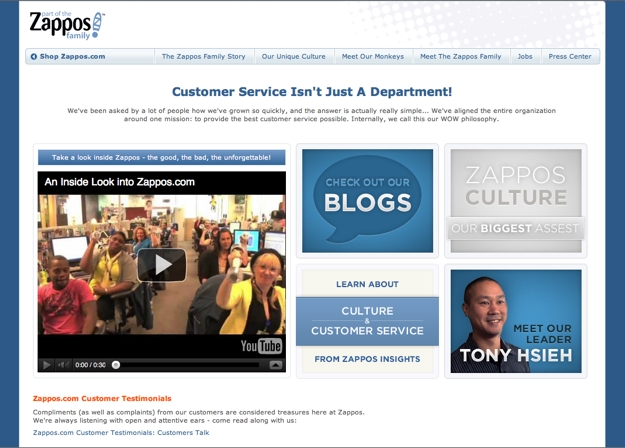
Zappos’ “About” page is all about the company’s culture. Yes, the history of the company and their leadership team are there as well, but the main focus of this section is their culture, including images of holiday celebrations and videos of their people. In perusing this content, you get a much better sense of who they are than you would by reading a a mission statement, a brief company history and a bulleted list of achievements and awards.
Zappos-About

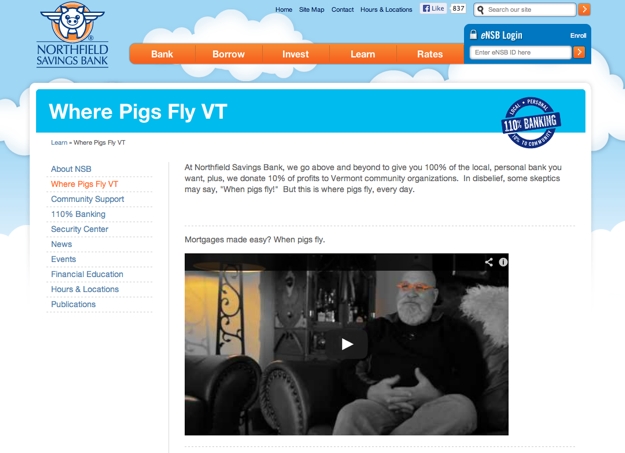
Another example of a website permeated with personality is Northfield Savings Bank. The sense of fun that they’ve built into their brand is an unexpected but delightful surprise, since banking isn’t generally synonymous with fun. Still, Northfield pulls it off on their website. Starting with the logo, which features a flying pig, they carry this theme through their entire site, turning the popular phrase “when pigs fly” into a rallying cry for how they go above and beyond in serving their customers. These stories are told on a subpage of their “About” section as part of their “Pig Stories” video series.
Northfield-About

It’s not all fun and games

Personality doesn’t have to be all about fun, holiday costumes or flying pigs. For many brands, fun would be an inappropriate trait – but that doesn’t mean you can’t display a personality.

Perhaps you are a not‐for‐profit organization that provides assistance to those in need in your community. Fun may not fit into your brand, but passion likely will. You can show that passion by using your “About Us” page or section to detail the impact your organization has had, profile the lives it has touched and convey the drive that you have to continue to do more.

Instead of simple facts and figures, personality will provide a well‐rounded, distinctive look at who your company or organization really is. That will be what sets you apart from your online competitors and their typical, boring “About Us” pages.

The more the merrier: Adding team bios

If adding unique personality to your company’s “About Us” page can help differentiate your organization, then adding individual bio pages for your employees can take this to the next level.

Granted, this approach is not a fit for everyone. A massive organization with thousands of employees obviously cannot have a page on their website for every individual. In these cases, the bio pages may be limited to board members or senior-level executives. For smaller organizations, however, it is certainly possible to feature each team member individually, and there is real benefit in doing so.

About a year ago, my company redesigned our website. During this process, we made the decision to include a section for “Our People” and give every employee a bio page of their own. We also decided to allow the unique personalities of those individual employees to shine through on their pages. Rather than using the professional headshots you would find on LinkedIn or in press releases, we encouraged our employees to submit photos of themselves that showed them outside the office environment. We received snaps of our team members atop mountains and glaciers, competing in races of one kind or another, enjoying vacations, feeding animals or just being silly and having fun. Taken as a whole, the photos show the variety of personalities and passions that make up our team.

Envision-About

For the bios, we included a short professional history, but we also asked our staff to share their hobbies, talents and an interesting or unusual story about themselves. Like the photos that accompany these bios, the stories and profiles we created reveal an incredible sense of diversity amongst our team.

What our customers are saying

Adding these individual bio pages on our website was a leap of faith for us. We were unsure how our clients and prospective clients would respond to this type of content. However, I am happy to report that our fears were unfounded, as the response has been overwhelmingly positive.

A number of our existing clients have remarked how they enjoy being able to see a picture of a team member before they are scheduled to speak or meet with that person. They also like to know a little something about them outside of their professional work. In more than one case, a customer and one of our team members have discovered shared hobbies or interests thanks to that team member’s bio page. This common interest has allowed them to engage in discussion and begin to foster a relationship that extends beyond the work they are paying us to do for them.

In terms of prospective clients, the feedback has been positive as well. In fact, we recently closed a deal where the client told us they hired us because of our bio pages. That client was wary about hiring a technology firm, fearing that we would only speak in techno‐babble and industry jargon and be on a different wavelength than their company. Seeing our interests outside the office, they immediately felt reassured that they could relate to us – a feeling they didn’t get when they looked at the websites of our competitors.

That’s a big win for personality if you ask me!

The argument against

The argument that I hear most frequently against adding personality to company or team bios is that it may turn some customers off and drive them away from your business. We worried about this ourselves when we decided to add the individual bio pages to our site.

It is true that a unique personality could drive some potential business away. But the better question is: should you really care? If you present your company’s true personality on your website, and that personality turns someone away, would you really have wanted to do business with them in the first place?

Yes, presenting a personality that is more than a safe buttoned-up suit-and-tie approach may turn some business away, but the reverse also holds true. The personality you reveal may very well be the deciding factor that sets your company apart in a  sea of sameness and actually attracts clients that may otherwise have passed you over – exactly as it did in the example I cited above. Had we not put our personality out there, we would not have won that business.

Finding the right fit

No one wants to turn business away, but the reality is that not every potential client will be compatible with the way you operate. Finding the right fit for your company is how you can achieve success in both the short and long term – because even if you do initially win over a company that isn’t truly a good fit for you, they are unlikely to stick around for long.

Finding the right fit allows you to build a relationship that may start with one job but grows stronger and deeper over time to create long‐term engagements and partnerships that can help drive success long after that first project becomes a distant memory. One of the ways to find this right fit is to always remain true to who your company is and not be afraid to let your personality shine through for all the world to see.

You’re not done yet

Finding ways to take “About Us” content from the typical company facts and figures to something that will differentiate your company is just one example of how rethinking content can make your website a more powerful conversion engine. Subsequent entries in this series will explore other common elements of website content that can be improved to bring more value to your visitors and greater returns for your business.