Eight Steps to Conquering Local Media
April 2011
By JoAnne Laffey Heckman

Anyone charged with the task of growing a business salivates at the idea of landing in the national media spotlight. The lure of the massive exposure that just one mention on CNN, Good Morning America or Oprah or in the pages of Bloomberg Businessweek or USA Today delivers is the driving force behind many PR campaigns.
However, it's important to remember that the cardinal rule of real estate also applies to media relations: location, location, location.
Of course your potential customers are tuned in to news from the national players. But these customers also exist as members of their local communities. They live locally, shop locally and do business locally. They also read, listen to and watch local media outlets.
No matter the size of your business or the scope of your target market, it's critical to develop a systematic approach to leveraging local media.
That's why no matter the size of your business or the scope of your target market, it's critical to develop a systematic approach to leveraging local media outlets to increase awareness, build trust in your brand and boost sales.
But if you want to make an impact, you must get strategic. Even at the local level, the competition is stiff for airtime and column inches.
Here are the fundamentals of breaking through the clutter and conquering the local media markets where you do business.
1. Do your homework.
Every market offers a wealth of opportunities for media coverage. Make it your mission to uncover all of the outlets available to you in each market and then narrow your hit list according to the demographics of your target market and their media consumption preferences.
For print media, you'll want to identify the major daily newspaper as well as smaller suburban weeklies and specialty publications that serve niche audiences like parents, women and retirees. Even the humble neighborhood association newsletter can be a valuable tool for showcasing your expertise or increasing awareness of your services.
On the broadcast side, local television news programs are a given, but don't forget about local daily or weekly radio and TV talk shows, which often have strong loyal followings. Morning and afternoon drive shows in particular attract a huge number of listeners during the daily commute. Locally produced call-in and talk radio can also be ideal targets for your promotional efforts, particularly if you can offer an expert to field questions or provide insight on topics of interest.
2. Go grassroots.
In your efforts to canvas the traditional media outlets in a given market, don't forget to also investigate the opportunities that may exist to gain exposure among locally based online communities.
In today's digital era, companies have unprecedented access to highly active, motivated and powerful influencers who can use social media platforms to disseminate information through their networks of friends and fans.
A successful local social media-driven PR campaign begins with researching the popular websites and blogs that cater to that specific market as well as identifying individuals have a strong following on Facebook or Twitter and whose needs and interests overlap with your offering.
Once you've pinpointed the sources that are the best fit in terms of both size and scope of their influence, that's when it's time to put trustcasting to work.
You must strive to create authentic relationships with these individuals who hold a position of leadership within their tribes. You must also overcome the burden of proof that your company and your products are worthy of their recommendation. By giving you their endorsement, they're putting their reputation and their credibility on the line. Make it worth their while, and they'll make it worth yours in return.
For example, when
Just Focus Massage & Wellness in Charlotte, North Carolina, needed to build awareness for their new FocusForward wellness seminar series, they identified popular local lifestyle blogs and approached the owners with the opportunity to attend the series free of charge in exchange for sharing their experience with their readers.
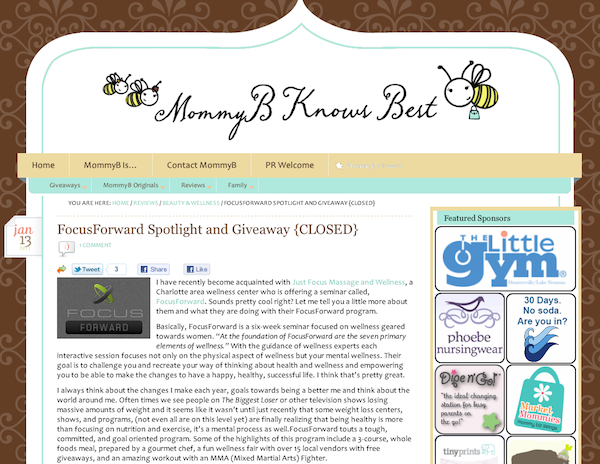
For a minimal investment, Just Focus was not only able to gain exposure to a highly targeted audience, they also reaped the benefits of the inherent trust that comes with the word-of-mouth recommendation of an established tribe leader.
3. Get to know the gatekeepers.
It's always a good idea to get to know the talk show hosts and reporters who cover topics of relevance to your products or services.
However, it's important to keep in mind that many of these individuals have relatively little control over the stories they report.
The real power players in local media are the editors (print), producers (radio) and assignment editors (television) who tell the writers, hosts and reporters where to be and what to talk about.
If you can get to know these gatekeepers and how to get in front of them, you'll greatly improve your chances of gaining the coverage you seek.
4. Develop genuinely local angles and events.
It's tempting to distribute the same press release or pitch to every outlet on your hit list, especially if you think your story offers a broad-based appeal.
However, going the extra mile to enhance your story with local interest will pay dividends in securing coverage in the markets that matter most to you.
For example, let's say you're an HR consulting firm pitching a story on the rising costs of health care. This is a compelling story that might gain coverage simply on the merits of its timeliness. However, you could significantly boost your chances of catching the eye of a local newspaper editor simply by including a few relevant details like how local cost increases compare to the nationwide average or the contact information for one of your consultants who is based in that location and can offer expert insight on how these changes are affecting the job market in that city.
5. Don’t forget the fundamentals.
Give your press release the “Would I read it?” test.
In addition to giving local media stories that offer local angles, local impact, local data and local people, you must also make sure you’re obeying the
fundamental rules of good storytelling.
Give your press release the “Would I read it?” test. Keep it simple and find hooks that tie into universal themes. Time your pitches to correspond with news cycles and seasons. Offer compelling visuals and expert spokespeople. Learn the audience demographics and the hot-button issues for each media outlet you plan to approach, and shape your story accordingly.
6. It’s all in the delivery.
Even the best pitch can fall flat it it’s not delivered in the correct manner and at the appropriate time.
An important part of building relationships with media professionals is getting to know how and when they prefer to be contacted. Does he live and die by his Blackberry, or will your e-mail just collect dust in his inbox? Would she like to hear from you, or would a phone call be an annoyance?
Timing is everything. You must make sure you’re on the radar when editorial decisions are being made and that you’re not trying to get attention when a reporter is up against a deadline.
Make sure you’re on the radar when editorial decisions are being made.
While every news organization works differently, there are a few rules of thumb that apply in most cases. Deadlines generally fall in the afternoon for daily print publications and three to four days ahead of publication for weeklies. Radio show producers typically have either weekly or bi-weekly meetings to plan upcoming topics and guests, while assignment editors for local television news broadcasts make their final determinations about where to dispatch camera crews and reporters on a daily basis, usually very early in the morning.
It’s important as well to be realistic and bear in mind that there can and will be times that no matter how strong or well-timed your story idea might be, no one will bite based on prior commitments or breaking news. Simply accept this graciously and move on to the next pitch.
7. Don't underestimate the personal touch.
Always remember that there are people on the receiving end of your stories.
"Media relations" can be a bit of a misleading term. It implies that you’re sending your press releases and pitches to some nameless, faceless news-generating machine.
In fact, nothing could be further from the truth. Always remember that there are people on the receiving end of your stories, so put your best relationship-building skills to work.
Call and introduce yourself to local writers, editors, bloggers and producers when you have nothing to actively pitch.
If possible, invite them to lunch to discuss their needs and interests as well as how they prefer to receive information, and demonstrate consideration for those preferences when you contact them in the future with story ideas. Do keep in mind that many media outlets have strict policies regarding gifts, so be sure to know and play by the rules.
8. Give ‘em the goods.
Product placement can go a long way in getting free advertising for your company, especially in radio.
If you run a bakery, deliver a tray of your most popular treats to the afternoon drive show personalities. Or if you own a day spa, invite the busy mom who hosts the morning show to enjoy a free day of pampering. While there are no guarantees, chances are good that you'll at least get an on-air thank you and maybe even a genuine, glowing review of your products or services.
Additionally, radio and TV producers are always looking for prizes for promotional giveaways and sponsors for events. These opportunities tend to cost much less than traditional paid advertising on the same stations but deliver high-impact exposure and referrals.
Let the conquest begin.
Remember: if you want to win the war of PR, you have to win the battles being fought in your own backyard. By employing these time-tested tactics, you can help to ensure that your pitches will stand out from the crowd and establish your company as a trusted source for local media outlets in the markets where you do business.
JoAnne Laffey Heckman has more than 15 years experience in the marketing communications field. Having worked for several leading international PR agencies and a Fortune 1000 company, she has led media relations initiatives for Motorola, Allstate, PriceWaterhouseCoopers, International Engine, ACT, Inc., The Tribune Companies, AonHewitt, Avery Dennison and ConAgra Foods as well as many smaller and start-up organizations. She currently lives in Greenville, South Carolina, where she serves as a consultant on media relations and communications strategies and lectures on various marketing-related topics.