We are the digital agency
crafting brand experiences
for the modern audience.
We are Fame Foundry.

See our work. Read the Fame Foundry magazine.

We love our clients.

Fame Foundry seeks out bold brands that wish to engage their public in sincere, evocative ways.


WorkWeb DesignSportsEvents

Platforms for racing in the 21st century.

Fame Foundry puts the racing experience in front of millions of fans, steering motorsports to the modern age.

“Fame Foundry created something never seen before, allowing members to interact in new ways and providing them a central location to call their own. It also provides more value to our sponsors than we have ever had before.”

—Ryan Newman

Technology on the track.

Providing more than just web software, our management systems enhance and reinforce a variety of services by different racing organizations which work to evolve the speed, efficiency, and safety measures, aiding their process from lab to checkered flag.

WorkWeb DesignRetail

Setting the pace across 44 states.

With over 1100 locations, thousands of products, and millions of transactions, Shoe Show creates a substantial retail footprint in shoe sales.

The sole of superior choice.

With over 1100 locations, thousands of products, and millions of transactions, Shoe Show creates a substantial retail footprint in shoe sales.

WorkWeb DesignRetail

The contemporary online pharmacy.

Medichest sets a new standard, bringing the boutique experience to the drug store.

Integrated & Automated Marketing System

All the extensive opportunities for public engagement are made easily definable and effortlessly automated.

Scheduled promotions, sales, and campaigns, all precisely targeted for specific demographics within the whole of the Medichest audience.

WorkWeb DesignSocial

Home Design & Decor Magazine offers readers superior content on designer home trends on any device.


  • By selectively curating the very best from their individual markets, each localized catalog comes to exhibit the trending, pertinent visual flavors specific to each region.


  • Beside the swaths of inspirational home photography spreads, Home Design & Decor provides exhaustive articles and advice by proven professionals in home design.


  • The art of home ingenuity always dances between the timeless and the experimental. The very best in these intersecting principles offer consistent sources of modern innovation.

WorkWeb DesignSocial

  • Post a need on behalf of yourself, a family member or your community group, whether you need volunteers or funds to support your cause.


  • Search by location, expertise and date, and connect with people in your very own community who need your time and talents.


  • Start your own Neighborhood or Group Page and create a virtual hub where you can connect and converse about the things that matter most to you.

June 2021
Noted By Joe Bauldoff

The Making and Maintenance of our Open Source Infrastructure

In this video, Nadia Eghbal, author of “Working in Public”, discusses the potential of open source developer communities, and looks for ways to reframe the significance of software stewardship in light of how the march of time constantly and inevitably works to pull these valuable resources back into entropy and obsolescence. Presented by the Long Now Foundation.
Watch on YouTube

529 Case studies in content marketing: Cooking up content with Williams-Sonoma

In our latest series, we're taking a look at three big brands that have gone all-in with content marketing and the lessons you can learn from their success.

December 2016
By Kimberly Barnes

Going the Distance: Four Ways to Build a Better Customer Loyalty Program for Your Brand

Loyalty programs are no longer a novelty. That means that yesterday’s strategies won’t work moving forward, so look for ways to rise above the noise, setting yourself apart from the cloying drone of countless other cookie-cutter programs.
Read the article

Going the Distance: Four Ways to Build a Better Customer Loyalty Program for Your Brand

article-thedistance-lg It’s easy enough for a customer to join your loyalty program, especially when you’re offering an incentive such as discounts. All your customer has to do is give out some basic information, and voila! They’re in the fold, a brand new loyalty member with your company. From there, it’s happily ever after. You offer the perks; they stand solidly by you, bringing you their continued business. Simple. Or is it? In reality, just how many of those customers are act ively participating in your loyalty program? Do you know? Sure, loyalty program memberships are on the rise according to market research company eMarketer, having jumped 25 percent in the space of just two years. However, that figure may be a bit misleading. The truth is that, while loyalty program sign-ups may be more numerous, active participation in such programs is actually in decline. At the time of the study, the average US household had memberships in 29 loyalty programs; yet consumers were only active in 12 of those. That’s just 41 percent. And even that meager figure represents a drop of 2 percentage points per year over each of the preceding four years, according to a study by loyalty-marketing research company COLLOQUY.

When discounts just aren’t enough

So what’s a brand to do? How can you make your loyalty program worth your customer’s while—as well as your own? After all, gaining a new loyalty member doesn’t mean much if your customer isn’t actively participating in your program. Consider this: Does your customer loyalty program offer members anything different from what your competitors are offering? Chances are your program includes discounts. That’s a given. And what customer doesn’t appreciate a good discount? But when every other company out there is providing this staple benefit in comparable amounts, it becomes less and less likely that customers will remain loyal to any one particular brand. Frankly, it’s all too easy for customers to get lost in a sea of loyalty member discounts. They’re everywhere. In fact, just under half of internet users perceive that all rewards programs are alike, according to a 2015 eMarketer survey. The key to success, then, is to differentiate your business from the crowd. If you can offer your customers something unique and valuable beyond the usual discount, chances are they’ll be more likely to stick with your brand. Here’s some inspiration from companies who get it.

Virgin: Reward more purchases with more benefits.

That’s not to say you need to get rid of discounts entirely. In fact, nothing could be further from the truth. Customers still love a good discount. The goal is to be creative in terms of the loyalty perks you offer. Take the Virgin Atlantic Flying Club, for example. As part of its loyalty program, the airline allows members to earn miles and tier points. Members are inducted at the Club Red tier, from which they can move up to Club Silver and then Club Gold. Here, it’s not just a discount. It’s status. And people respond to feeling important, elite. Still, even where the rewards themselves are concerned, Virgin is motivating loyalty customers with some pretty attractive offers. At the Club Red tier, members earn flight miles and receive discounts on rental cars, airport parking, hotels and holiday flights. But as members rise in tiers, they get even more. At the Club Silver tier, members earn 50 percent more points on flights, access to expedited check-in, and priority standby seating. And once they reach the top, Club Gold members receive double miles, priority boarding and access to exclusive clubhouses where they can get a drink or a massage before their flight. Now that’s some serious incentive to keep coming back for more. Discounts are still part of the equation – but they are designed with innovation and personal value in mind, elevating them to more than just savings.

Amazon Prime: Pay upfront and become a VIP.

What if your customers only had to pay a one-time upfront fee to get a year’s worth of substantial benefits? It may not sound like the smartest business idea at first glance. But take a closer look. Amazon Prime users pay a nominal $99 a year to gain free, two-day shipping on millions of products with no minimum purchase. And that’s just one benefit of going Prime. It’s true that Amazon loses $1-2 billion a year on Prime. This comes as no surprise given the incredible value the program offers. But get this: Amazon makes up for its losses in markedly higher transaction frequency. Specifically, Prime members spend an average of $1,500 a year on Amazon.com, compared with $625 spent by non-Prime users, a ccording to a 2015 report from Consumer Intelligence Research Partners.

Patagonia: Cater to customer values.

Sometimes, the draw for consumers isn’t saving money or getting a great deal. The eco-friendly outdoor clothing company Patagonia figured this out back in 2011, when it partnered with eBay to launch its Common Threads Initiative: a program that allows customers to resell their used Patagonia clothing via the company’s website. Why is this program important to customers? And how does it benefit Patagonia? The company’s brand embraces environmental and social responsibility, so it was only fitting that they create a platform for essentially recycling old clothing rather than merely throwing it away. The Common Threads Initiative helps Patagonia build a memorable brand and fierce loyalty by offering its customers a cause that aligns with deep personal values. OK, so their customers get to make a little money, too. Everybody wins.

American Airlines: Gamify your loyalty program.

If you’re going to offer your customers a loyalty program, why not make it f un? After all, engagement is key to building a strong relationship with your customer. And what better way to achieve that goal than making a game of it. American Airlines had this very thing in mind when it created its AAdvantage Passport Challenge following its merger with USAirways. The goal: find a new way to engage customers as big changes were underway. Using a custom Facebook application, American Airlines created a virtual passport to increase brand awareness while offering members a chance to earn bonus points. Customers earned these rewards through a variety of game-like activities, from answering trivia questions to tracking travel through a personalized dashboard. In the end, participants earned more than 70 percent more stamps than expected – and the airline saw a ROI of more than 500 percent. The takeaway: people like games.

Stand out from the crowd.

Your approach to your customer loyalty program should align with your overall marketing approach. Effective branding is about standing out, not blending it. Being memorable is key. To this end, keep in mind that loyalty programs are no longer a novelty. That means that yesterday’s strategies won’t work moving forward, so look for ways to rise above the noise, setting yourself apart from the cloying drone of countless other cookie-cutter programs.


March 2021
Noted By Joe Bauldoff

The Case for Object-Centered Sociality

In what might be the inceptive, albeit older article on the subject, Finnish entrepreneur and sociologist, Jyri Engeström, introduces the theory of object-centered sociality: how “objects of affinity” are what truly bring people to connect. What lies between the lines here, however, is a budding perspective regarding how organizations might better propagate their ideas by shaping them as or attaching them to attractive, memorable social objects.
Read the Article

May 2011
By The Architect

Should There Be an App for That?

Is your idea app-worthy? Put it to the test.
Read the article

Should There Be an App for That?

app-image

Getting into your customers’ pockets is no easy task.

With the tablet wars heating up and smartphone sales skyrocketing, at some point, the thought is bound to cross your mind: Is it time to create an app? The lure of being with your customers everywhere they go and being readily accessible with the tap of a finger is certainly hard to resist. And with over 350,000 iOS apps in Apple's App Store and over 200,0000 apps in Google's Android Market, it’s clear that many companies have eagerly climbed aboard the app development bandwagon. Thanks to a proliferation of DIY app templates, the barriers to entry in the app marketplace are not as steep as they once were. But you can't simply judge the merits of creating an app as you would would any other marketing tactic. Instead, you should look at your potential app as a product in and of itself. You wouldn't put time and money into developing a product without a reasonable amount of confidence that a market exists for it. Same goes for an app. You can build it. You can get it into the app store. But if it's not something people want, your efforts will be for naught.

Your app must meet these eight basic criteria, or else it's not worth the investment:

1. It must be designed around business growth objectives.

To justify the necessary investment, your app must be aimed at promoting the growth of your business, whether it does so by making it easier for your customers to buy from you or keeping your brand at the forefront of their awareness. Sure, plenty of big names have created vanity apps that don’t serve a business growth function, but that’s not a luxury the average company can afford. For example, Mercedes offers an iPad game called SLS AMG HD that allows users to put their driving skills to the test through a series of tunnel challenges. Mercedes SLS AMG Sure, it’s a slick-looking gimmick. But is it actually doing anything to improve the company’s bottom line? Does anyone who is inclined to buy a Mercedes really need an iPad racing game to tip them over the edge? An app in and of itself is not a marketing campaign. If your goal is to boost the visibility of your brand, creating an app is a very indirect and costly means to reach your desired end. Remember that you'll be competing with hundreds of thousands of other apps to be discovered by smartphone users. Your chances of creating something so new, so different and so out-of-the box that it will go viral and jump to the top of the download charts are slim to none. What's more, even the number of downloads your app gets is no guarantee of ongoing exposure to your customers. According to a recent study, as many as twenty-six percent of apps are opened only once after download. With odds like that, if your sole purpose is elevating the visibility of your brand, there are no shortage of other tactics – from SEO to pay-per-click advertising to social media-based PR campaigns – that will likely deliver a better ROI.

2. Its utility must be customer-driven.

No matter what, your app development process shouldn't be an exercise in ego-stroking. Forget what you think is cool or cutting-edge and look at your app through your customers' eyes. For your app to be successful, it needs to offer something people want, whether that's in the form of utility, convenience, content or all of the above. For the most part, your customers use their mobile devices for one of two purposes: productivity or entertainment. If you want to create an app that entertains, be prepared to bring the big guns because you're competing in a space with the heavy-hitters, from Facebook, Twitter and YouTube to a slew of professional game developers. The productivity space is easier to enter, but conquering it is still no easy feat. A useful productivity-oriented app must make it easy for your customers to accomplish the types of tasks they commonly perform while on-the-go. If your app is content-driven, it needs to be encyclopedia-worthy to warrant a spot on the reference shelf of your customer’s mobile device. It must be comprehensive and updated frequently, and its interface must be ultra-searchable and scannable. Whole Foods offers a great content-based app. Users can search its extensive library of recipes by keyword, input ingredients they have on-hand to get suggestions and create shopping lists on-the-fly. Search results are even classified by dietary preference, such as gluten-free or low-fat. Whole Foods Recipes This type of utility aligns squarely with Whole Foods’ target market. Undoubtedly, their app is the go-to resource for many health-conscious, time-strapped working parents who leave the office with no idea of what they’re going to make for dinner when they get home.

3. It must offer an optimal balance of usefulness and simplicity.

Your app should not attempt to be all things to all potential users, or it will be doomed to failure. Likewise, it also shouldn't simply be a mirror of your website's features. If that's your plan, you'll be better served by optimizing your existing site for mobile browsers. Generally speaking, the more features you try to cram into an app, the less intuitive it becomes to use. And as hard as it may be to imagine, app users are even less patient and more fickle than Web surfers. If your app is difficult to figure out or frustrating to use, they'll wipe you from their phone with nary a second thought. Therefore, it’s critical that your app’s purpose is clearly defined and that its functionality is streamlined. The FedEx Mobile for iPhone app is a perfect example of this balance of utility and simplicity. FedEx is a massive global corporation that offers a broad array of services to a highly diverse customer base. Its app, however, is limited to four main functions: obtaining a quote, creating a shipping label, tracking a package and finding a location – exactly the type of time-sensitive features you need at the ready when you’re trying to get that all-important document out in tonight’s shipment or awaiting an important delivery. FedEx Mobile

4. It must be mobility-oriented.

There are some tasks people like to do on their phones and some they do not. Any task that involves too many steps and is not urgent in nature is not going to be something your customers would choose to do on their phone rather than just waiting until they are in front of their computer screen again.

5. It must take advantage of the mobile device’s unique features.

Mobile devices have a number of built-in features that even many laptops don’t necessarily have, such as GPS, the ability to deliver push notifications, a camera and video camera. If you don’t plan to tie the utility of your app to any of these functions, it’s hard to justify creating a dedicated mobile app rather than just enhancing your current site to provide an optimal experience for mobile users. Amazon's Price Check is a great example of an app that takes advantage of the phone's camera function to allow users to scan barcodes and compare prices on-the-go. Amazon Price Check GPS is a little more tricky to use wisely. A lot of branded apps – from Gap's StyleMixer to USPS Mobile – use GPS to allow users to find their closest brick-and-mortar location. As an auxiliary feature it's a nice convenience for users who are already plugged into the app, but this type of function is not enough to justify the existence of an app in and of itself, as there are plenty of other mapping and searching apps that can deliver the same information with broader utility. Also, you should weigh the pros and cons of integrating push notifications carefully. If you can provide legitimate value to your customers with timely alerts, that's fine. But if you cross the line into intrusiveness, you're just asking to get deleted.

6. It must be applicable to a broad customer base.

The Chipotle Mobile Ordering app lets users place a completely customized order and pay directly from their phone in advance of arriving at the store. For a national chain with thousands of time-starved customers who have little patience for waiting in line, the app represents the perfect marriage of utility and marketing savvy. Chipotle Ordering But apps like this require a certain scale to make sense. If you're a mom-and-pop bakery, you could theoretically develop an app that would let your customers design their own cupcakes and place their order right from their phone. While it would surely be a fun gimmick, it doesn't fulfill a broad-based need, and the app's ability to generate additional revenue would probably never offset the cost to create and maintain it.

7. It must be well-designed and thoroughly tested before launch.

The app marketplace is no place for experimentation. You have to get it right out of the gate. If you go live prematurely with an app that's underdeveloped, lacking utility or plagued with bugs, your bad reviews will haunt you for a long time. What's more, disenchanted users won't be likely to give you another shot even if you come out with something better later.

8. It must continue to evolve.

If you’re going to get into the app development game, you must be prepared to be in it for the long-haul. Once you launch your app, your job is only just beginning. App developers have raised the bar of user expectation for updates. You must monitor your feedback and respond with interface tweaks that provide a better experience. You should also add to and improve upon the functionality of your app regularly and keep it fresh with current data. If users see an app that has gone stale on the shelf, they're not going to be inclined to download it.
April 2012
By Sufyan bin Uzayr

When Less is More: An Introduction to Minimalist Website Design

What exactly is minimalist design? And is it the right choice for your site?
Read the article

When Less is More: An Introduction to Minimalist Website Design

Minimalism is a trend that garners a lot of debate and discussion in the website design community. As a result, chances are good that you’ve heard of minimalist design and seen its principles in practice on sites that you visit day in and day out. But what exactly is minimalist design? And is it the right choice for your site?

Minimalism defined

In website design, minimalism can easily be construed as plain, lackluster or easy to accomplish. However, that is quite far from the truth. To the contrary, minimalism is a philosophy of web design that strives to eliminate all unessential features and elements in order to enhance usability by providing a clean, streamlined browsing experience that is absent of unnecessary distractions and clutter.

Focus

Every successful minimalist design starts with a crystal-clear vision of the purpose of the site and the key messages it needs to convey. Before any design choices are made, it’s critical to outline the goals and content of the site. This requires determining what information is most vital to visitors and arranging it in order of significance. You might actually be amazed to discover how little information is actually required to help users make decisions or accomplish their goals.

Typography

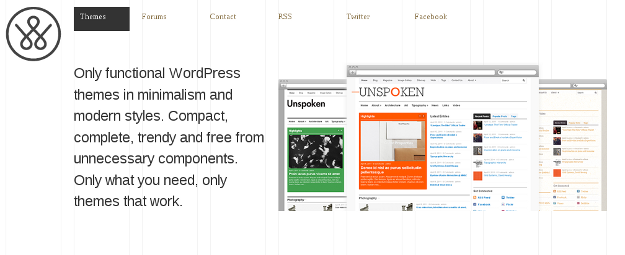
Because minimalist design is reduced to only its most essential visual elements, the site’s content takes center stage. As a result, typography is key to capturing the user’s attention. The choice and usage of typefaces in minimal design is critical to creating a unique look and feel that makes a lasting impression on visitors. Therefore, it’s important to choose a combination of typefaces that both reflect the personality of the brand and provide a clean, pleasurable user experience. Yet again, restraint is key, as using too many different fonts can make the site feel unorganized and chaotic. Beyond the choice of typeface, attention to detail in size, color, spacing and weight is important to ensuring readability and defining the overall aesthetic of the site. The WPShower website offers a good example of the role typography plays in setting the tone for minimalist design, with an easy-to-read yet somber font for the main caption and a quiet font for the menus. 2-typography-minimal
Color

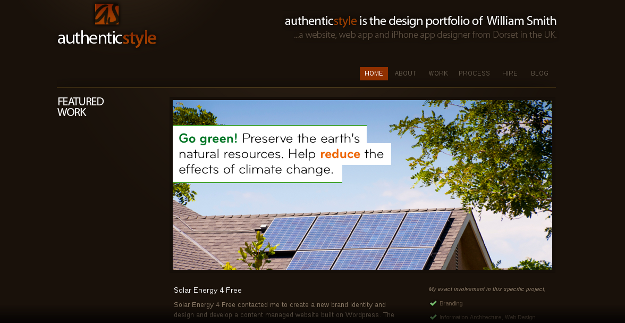
A common myth of minimalism in website design is that it entails a lack of color. While many minimalist websites do feature a color palette that is limited to black and white, this is merely an aesthetic choice, not a requirement. Instead, just as with all other elements of minimalist design, color should be deployed in ways that emphasize focus and restraint. Minimalist sites commonly employ a single continuous background color that sets the mood or tone for the site. A carefully chosen accent color is then employed to draw the user’s attention to key features of the site, such as navigational elements or important points within the content. It’s important to ensure that the accent color is not used to excess, or else it will lose its impact. For instance, take a look at authentic style, the design portfolio of William Smith. The background is brown, with another shade of that very color used as accent, yielding an overall effect that is minimal, clean and neat. 1-color-minimal
Layout

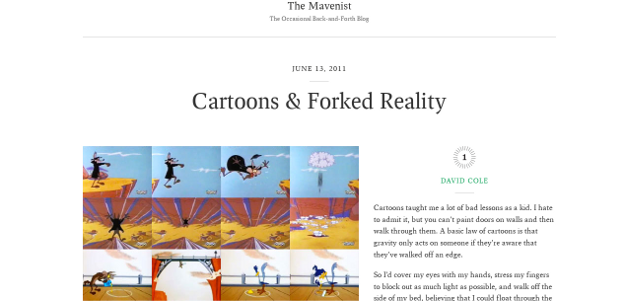
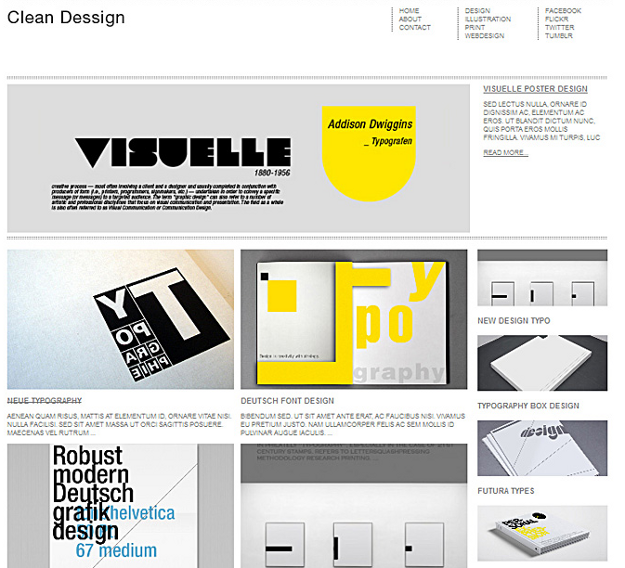
Layout is a make-or-break element of minimalist design. It requires proper execution and an absolute lack of ambiguity. All elements should work together to keep the primary focus on the site’s content. Minimalist design requires special attention to certain key elements. For example, the company name and logo should be in a prominent location in order to establish the site’s identity and promote the brand. Next, as with any site, ease of navigation is critical. Navigation menus should be convenient to locate and use on any device or platform. If visitors are forced to scavenge for information, the website will not be popular, no matter how beautiful it is. For instance, take a look at the website of The Mavenist – a minimalist design featuring awesome typography and a user-friendly layout. 5-mavenist-minimal Also, it is often incorrectly assumed that a minimal website design excludes images and graphics. After all, we are concentrating on good typography, few colors and highly structured layouts, so images will only introduce chaos, right? Actually, no. Images are an important component of any website’s content, and in minimalist design, images can be used to powerful effect in the absence of other competing graphical elements. For example, take a look at the Clean Dessign theme. It is loaded with images and yet maintains restraint in terms of layout and design. 3-clean-dessign
White space

White space – also known as “negative space” – simply refers to the area on a web page that is not occupied by any design elements or text. Even though it is called “white space,” it does not actually have to be white. This term merely refers to the space that exists between content. White space is a critical element of any design – not just minimalism. It can be tempting to fill this empty space in order to make the best use of the available real estate on the page. However, in fact, it is this space between content that helps users make sense of the page and understand which elements are most important. In minimalist design, white space is used to help lead and direct the user’s attention. For example, content that stands alone will draw focus immediately. Furthermore, white space can also be used to group similar items together as well as to create separation and differentiate between elements of various levels of importance. 4-whitespace-minimal
Getting started with minimalist design

While minimalist design is appealing in its simplicity, it’s not the right choice for every site. It works best for those sites that are centered around serving a singular purpose – whether that’s selling an app or presenting a portfolio of work. So how can you determine whether your site would benefit from being redesigned with a minimalist approach? The answer is more simple than you might think. No matter what business you’re in, your website exists to help that business grow. Therefore, every decision you make with regard to your site should be based on whether it will help to advance your business growth objectives. A good place to start is by evaluating your current website. Make a list of its various features and components. Now arrange that list in order of usage, with the most commonly used ones on top. From there, go down the list and eliminate any that are not often used or are not essential to supporting the business objectives of your site. If what remains on the list reflects a few relatively simple ideas and functions, your site could be a good candidate for a minimalist redesign. Further exploration with an experienced website design firm will help you identify the ways that your site could be simplified and streamlined. As always, usability trumps all, so any changes must be driven by the goal of providing the best possible experience for visitors that motivates them to take action. Implementing minimalism just because it is a popular trend could ultimately undermine your site’s ability to help you capture and convert new customers. But if your aim is to present a focused message in a powerful way, minimalist design will provide a stage where those ideas can shine.